
State Management in 2025: Signals, Server Components, and Store Slices—Choosing the Right Mix
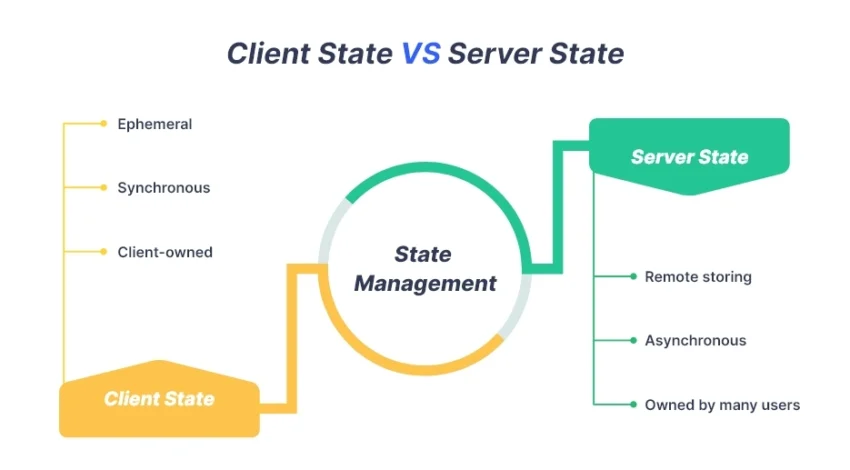
Modern front-ends juggle three kinds of state: server state (fetched data that changes on the backend), client UI state (local interactions like modals and inputs), and derived/computed state (filters, aggregations, memoized views). In 2025, the tooling landscape has shifted: React Server Components (RSC) reduce data-fetch boilerplate, “signals” enable fine-grained reactivity across frameworks, and store “slices” keep global state modular. This guide clarifies when to use each approach, how to avoid over-rendering, and patterns that scale without ceremony.
The three categories of state, explicitly
- Server state
- Source of truth: your API/DB.
- Characteristics: cacheable, refetchable, can be stale for brief windows.
- Needs: fetching, caching, revalidation, optimistic updates.
- Client UI state
- Source of truth: the browser runtime.
- Characteristics: ephemeral, interaction-driven (open/close, hover, input).
- Needs: instant updates, isolation per component, minimal global surface.
- Derived/computed state
- Source of truth: functions over other state.
- Characteristics: cached/memoized for performance; never manually set.
- Needs: correctness, invalidation on dependency change, low overhead.
Mapping state to the right mechanism is half the battle.
Server Components and data boundaries
Server-first rendering (e.g., React Server Components and equivalents in other ecosystems) moves data loading to the server edge, delivering HTML quickly and reducing client bundle size. The rule of thumb:
- Fetch on the server by default for lists, detail pages, and dashboards.
- Hydrate on the client only where interactivity is required (forms, search boxes, live filters).
- Revalidate on navigation or action boundaries to keep UI honest.
Good pattern: co-locate a server data loader with the component tree, then pass only the minimal interactive props into a client component:
// Server component
export default async function ProductsPage() {
  const products = await db.listProducts(); // server fetch
  return <ProductsClient initial={products.slice(0, 20)} />;
}

// Client component
"use client";
export function ProductsClient({ initial }) {
  const [query, setQuery] = useState("");
  const results = useMemo(
    () => initial.filter(p => p.name.toLowerCase().includes(query.toLowerCase())),
[initial, query]
); return (/* render search UI */); }
This keeps server state server-side and UI state local, with a clean seam between them.
Signals: fine-grained reactivity without rerender storms
Signals (available in frameworks like Solid, Preact/Signals, Angular’s Signals, and community packages for React) track dependencies at the data level rather than component level. When a signal changes, only consumers that read it update—no full tree re-render.
Use signals for:
- High-frequency updates (typing, sliders, animation-adjacent logic).
- Shared but small bits of UI state (theme, active tab, expanded row).
- Derived values that must update instantly without re-rendering parents.
Example with signals (pseudo-React style):
import { signal, computed } from "@preact/signals-react";

const cartItems = signal([] as { id: string; price: number; qty: number }[]);
const subtotal = computed(() =>
  cartItems.value.reduce((sum, i) => sum + i.price * i.qty, 0)
);

// In components:
function AddToCart({ product }) {
  return (
    <button onClick={() => cartItems.value = [...cartItems.value, { id: product.id, price: product.price, qty: 1 }]}>
      Add
    </button>
  );
}

function CartTotal() {
  return <strong>Total: ${subtotal.value.toFixed(2)}</strong>;
}
Here, CartTotal reacts to subtotal only; unrelated components remain untouched.
Store slices for global, cross-route state
Global state is often overused. Keep it lean and slice-based:
- What belongs globally: auth session, feature flags, user preferences, cart, cross-route search filters.
- What stays local: component toggles, transient form values, per-page UI.
- Design for modularity: create slices with a single responsibility and typed actions/selectors.
Zustand-style slice:
import { create } from "zustand";

type CartItem = { id: string; price: number; qty: number };
type CartSlice = {
  items: CartItem[];
  add: (i: CartItem) => void;
  updateQty: (id: string, qty: number) => void;
  clear: () => void;
};

export const useCart = create<CartSlice>((set) => ({
  items: [],
  add: (i) => set(s => ({ items: [...s.items, i] })),
  updateQty: (id, qty) => set(s => ({ items: s.items.map(it => it.id === id ? { ...it, qty } : it) })),
  clear: () => set({ items: [] })
}));
Pair slices with selectors to avoid re-renders:
const totalSelector = (s: CartSlice) => s.items.reduce((sum, i) => sum + i.price * i.qty, 0);
const total = useCart(totalSelector);
Server state libraries still matter
Even with server rendering, you’ll need client fetching for:
- Infinite scroll, background refresh, or real-time updates.
- Widgets that outlive a page (e.g., a chat panel).
- Offline-first or PWA behavior.
Pick a client cache (SWR, React Query, Apollo, urql) when you need:
- Deduplication of parallel requests.
- Stale-while-revalidate semantics.
- Mutations with optimistic updates and rollback.
Rule: treat server state as read-through cache with declared invalidation. After mutations, invalidate relevant keys or tags to keep the UI consistent.
Derived state: compute, don’t store
Storing derived values invites bugs. Prefer computed/selector patterns:
- Selectors (e.g., Reselect/Zustand selectors) cache results based on input references.
- Signals’ computed values recalc only when inputs change.
- Memoization in component scope (
useMemo) is acceptable for small computations, but avoid relying on it for global correctness.
Example derived filter:
const filter = signal({ q: "", minPrice: 0 });
const filtered = computed(() =>
  products.value
    .filter(p => p.price >= filter.value.minPrice)
    .filter(p => p.name.toLowerCase().includes(filter.value.q.toLowerCase()))
);
No extra state to synchronize; invalidation is automatic.
Performance guardrails (INP/LCP friendly)
- Render less: split routes; defer hydration for non-critical islands.
- Subscribe narrowly: use selectors or signals to avoid tree-wide updates.
- Batch updates: group state changes inside a single transaction/tick where the framework supports it.
- Virtualize long lists: only render what’s visible.
- Defer heavy work: use web workers for parsing/formatting that would block the main thread.
Checklist before shipping:
- Are we hydrating only interactive components?
- Do subscriptions select minimal slices?
- Are expensive computations derived, not stored?
- Do mutations trigger explicit invalidation/revalidation?
- Do we measure INP/LCP/CLS in production with RUM?
Error handling and consistency
- Authoritative writes: mutations should happen server-side; client updates are optimistic hints only.
- Idempotency keys: prevent duplicate writes on flaky networks.
- Conflict resolution: for collaborative UIs, consider vector clocks or last-write-wins at field granularity.
- Rollback strategy: when an optimistic mutation fails, show a clear toast and revert the local cache.
Security and privacy notes
- Never place secrets in client state. Keep tokens in httpOnly cookies.
- Minimize PII in caches. Encrypt at rest if you persist offline data.
- Feature flags and entitlements should be validated server-side; the client may reflect visibility, not authority.
Migration playbook
- Inventory state: classify by server/client/derived.
- Move queries server-side where possible; pass minimal props to client.
- Introduce a client cache for the few components that need live refetch or optimistic UX.
- Replace global blob stores with small dedicated slices + selectors.
- Adopt signals where micro-updates cause re-render pain (inputs, counters, hover states).
- Instrument RUM: track Web Vitals by route and interaction type; verify improvements after each change.
Anti-patterns to avoid
- Everything global: bloats renders and makes reasoning hard.
- Duplicated sources of truth: storing server results and a parallel “edited” copy without a reconciliation plan.
- Computed state saved as mutable: leads to stale UIs and logic drift.
- Hydrating the entire page for small interactions: prefer islands or component-level hydration.
- Hidden coupling: cross-component reads through shared mutable objects; use explicit stores or signals instead.
Practical defaults (opinionated)
- Pages and heavy data: fetch on the server; stream HTML.
- Local interactions: component state or signals.
- Cross-route essentials: small store slices with memoized selectors.
- Live bits: a client cache with SWR/React Query plus explicit invalidation after writes.
- Derivations: selectors or computed signals—never hand-maintained fields.
Conclusion
A maintainable state strategy aligns where data lives with how it changes. Use server components to own server state and shrink bundles, apply signals to sharpen interactivity without over-rendering, and keep global concerns modular with slices and selectors. Measure the impact through real user monitoring, tune subscriptions, and treat derived data as a function—not a variable. Done this way, your app remains fast, predictable, and ready to grow.


