
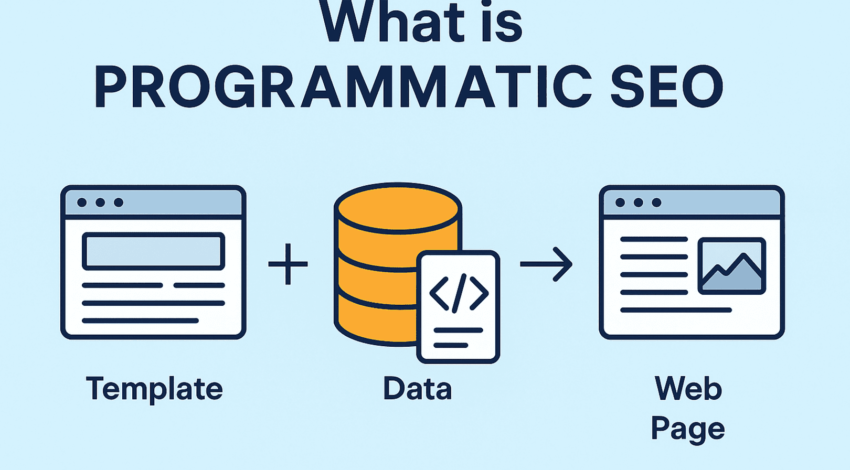
Programmatic SEO (pSEO) turns structured data into hundreds or thousands of useful pages—not thin duplicates. The goal is a repeatable pipeline that ships high-quality, intent-matched pages with strong UX, correct schema, and zero indexing waste. Here’s a pragmatic blueprint you can launch this week and scale safely.
1) Pick the Right Use Cases (Intent First)
Programmatic works when user intent is systematic:
- Directories & catalogs: “Best X in Y,” “Pricing of X by region,” “Specs and alternatives of {product}.”
- Comparison matrices: “{Tool} vs {Tool},” “{Framework} vs {Framework} for {Use-case}.”
- Feature pages: “How to {verb} with {platform},” with step tables varying by platform.
- Localized data summaries: “Cost of {service} in {city},” updated monthly.
Sanity check: If a human wouldn’t bookmark the result, don’t generate that page.
2) Data Model Before Templates
Design a normalized dataset. Every column should map to real user questions.
Minimal schema (example)
Entities: tools(id, name, vendor, category, price, rating, last_updated)
Locations: cities(id, name, region, country, population)
Relations: availability(tool_id, city_id, price_local, currency, updated_at)
Comparisons: pairs(a_tool_id, b_tool_id, verdict, pros, cons)
Rules:
- Prefer primary sources or reliable APIs; store
source_urlandfreshnesstimestamps. - Add a
confidencescore per record; exclude low-confidence rows from publish. - Keep units standardized; convert at render time for locale.
3) Page Archetypes (Templates That Earn Clicks)
Design 3–5 high-quality templates, not 30 mediocre ones:
- City Hub:
{category} in {city}- Intro with one-sentence answer (cost, availability).
- Top 5 options (cards), map or table, FAQ, how pricing works locally, sources.
- Entity Detail:
{tool} Pricing & Features- Specs table, pros/cons, alternative suggestions, change-log snippet.
- Versus Page:
{toolA} vs {toolB}- Head-to-head table, decision tree (“Choose A if…; B if…”), performance footnotes.
- Query Collection: “Best {category} for {use-case}”
- Criteria upfront, ranked list with explainable scoring formula.
Each template ships with: unique intro, scannable H2s, data tables, a conclusion, and internal links to siblings/parents.
4) Content Generation: Human-in-the-Loop
Avoid pure templating monotony. Blend deterministic text with curated snippets.
Deterministic copy blocks
- One-line summary:
In {city}, average {category} price is {median_price} {currency}, updated {month YYYY}. - Variance note:
Prices vary by neighborhood; {p90} is {value}.
Editorial overlays
- For top 10% traffic pages, add human commentary: pitfalls, local quirks, mini case studies.
- Maintain an override table to replace default intros or rankings for special cases.
Style rules
- Short paragraphs (≤ 4 lines), bullets for lists, and a single-sentence TL;DR.
5) Internal Linking & Taxonomy
Programmatic pages die without a clear graph.
- Parent → child: Category hub links to all city pages (paginated, crawlable).
- Child → parent: Each city page links back to its category hub and the country hub.
- Siblings: Link 3–5 related cities/tools; keep anchors descriptive.
- Breadcrumbs: Output
Home > Category > Citywith schema.
Add a “Related comparisons” widget on entity pages to drive exploration and crawl coverage.
6) Technical Hygiene That Scales
- Canonicals: One canonical per page; no self-referencing loops or parameters.
- Sitemaps: Split by template (
/sitemaps/city.xml,/sitemaps/entity.xml), updatelastmodonly on real data change. - Noindex guard: Any page with missing key fields (e.g., < 3 rows of data) auto-noindex until complete.
- Pagination: Use clean URLs (
/cities?page=2), stable sorting, and discoverable “view all” with careful performance. - Performance: Edge render HTML; hydrate only interactive sections. Preload LCP image only.
7) Structured Data (JSON-LD)
Attach correct schema per template:
- City Hub →
CollectionPage+ItemList - Entity Detail →
ProductwithOffer,AggregateRatingwhen real - Versus Page →
FAQPage(for “Which is better for X?”) +BreadcrumbList - Organization site-wide: logo, sameAs, contact
Example (ItemList snippet)
<script type="application/ld+json">
{
 "@context": "https://schema.org",
 "@type": "CollectionPage",
 "name": "Best Coworking Spaces in Austin (2025)",
 "hasPart": {
   "@type": "ItemList",
   "itemListElement": [
     {"@type":"ListItem","position":1,
      "item":{"@type":"LocalBusiness","name":"Space A","url":"https://example.com/austin/space-a"}},
     {"@type":"ListItem","position":2,
      "item":{"@type":"LocalBusiness","name":"Space B","url":"https://example.com/austin/space-b"}}
   ]
 }
}
</script>
8) Quality Gates & Governance
Set automated gates before publish:
- Uniqueness: Title + H1 + intro must be unique. Enforce via similarity threshold (e.g., cosine < 0.8 vs siblings).
- Data completeness: Required fields present (price, availability, update date).
- Readability: Flesch/Kincaid range; flag super-long sentences.
- Vitals: LCP/INP/CLS budgets pass in lab and field for new pages.
- Link checks: No 404s; outbound links rel attributes correct.
Fail fast in CI; do not push half-baked pages that poison crawl trust.
9) Freshness & Change Management
- Rolling updates: Re-pull data weekly/monthly per category; change only what changed.
dateModifiedpolicy: Update only if content or data changed materially.- Diff previews: Show before/after to editors; require approval for rank/score changes > X%.
For volatile datasets (prices), expose an “Updated on” badge above the fold.
10) Measurement that Matters
Dashboards segmented by template:
- Coverage: Published vs eligible vs noindexed.
- Discovery: % pages with impressions in last 28 days.
- Engagement: CTR, read time, scroll depth, table interaction rate.
- Conversion: CTA clicks per template (outbound, signup, demo).
- Quality: Indexation errors, soft 404s, duplicate clusters, CWV pass rate.
Add alerts for: spike in excluded URLs, sudden canonical mismatches, LCP regressions, or 5xx bursts on template routes.
11) Common Pitfalls (and Fixes)
- Thin pages at scale: Add minimum content thresholds; auto-noindex until met; aggregate nearby entities into a single useful page.
- Template monotony: Rotate lead images, vary intros, include local tips.
- Faceted explosion: Strict allowlist of indexable facets; canonicalize the rest.
- Opaque rankings: Document scoring formulas; show simplified “Why this rank” notes to users.
- Data rot: Show “data confidence” labels; prioritize refresh for top-traffic pages.
12) Launch Checklist
- Data normalized, confidence scores present, units standardized.
- 3–5 polished templates with unique copy blocks and FAQs.
- Canonicals, sitemaps, breadcrumbs, and JSON-LD wired.
- Noindex guard for incomplete pages; error budgets enforced.
- Internal link graph (parent/child/siblings) verified.
- Core Web Vitals within budget on template test URLs.
- Monitoring & alerts live; weekly refresh job scheduled.
Bottom Line
Programmatic SEO wins when data quality, template craft, and technical discipline meet. Start small with one category, nail the template and linking, wire freshness and QA gates, then scale. The compounding effect isn’t from raw page count—it’s from shipping consistently useful pages that earn crawl trust and user satisfaction.


