
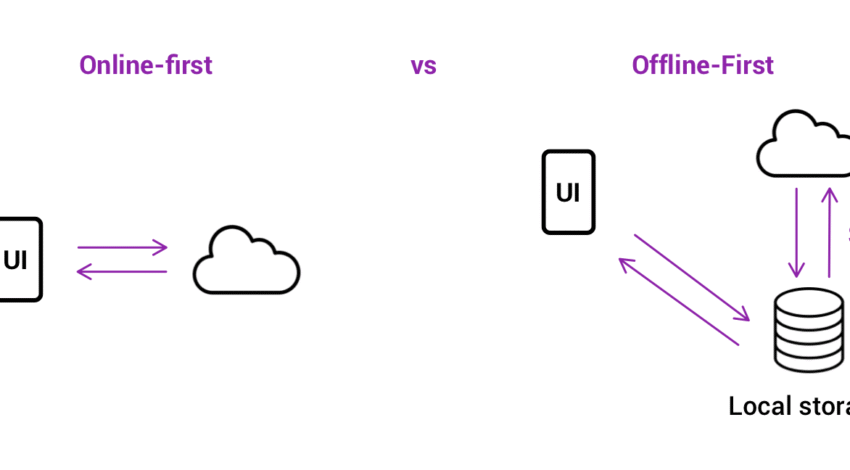
An offline-first approach treats the device as the system of record most of the time and the backend as an eventual consistency partner. Done correctly, users get instant interactions, no data loss on flaky networks, and predictable sync—even across multiple devices. This guide lays out a practical, framework-agnostic blueprint usable with Kotlin (Android), Swift (iOS), Flutter, or React Native.
1) Core Principles
- Local-first writes: All create/update/delete operations land in a durable local store immediately. Network is opportunistic, not blocking.
- Deterministic sync: A single, well-defined protocol moves changes between client and server with idempotency, retry, and versioning.
- Conflict visibility: Collisions are expected. Detect them deterministically and resolve with rules that users and developers can understand.
- Background resilience: Work continues when the app is backgrounded or the OS reclaims resources, within platform limits.
- Observability: Every mutation and sync step is traceable for audit and debugging.
2) Data Model & Storage
Choose a store that’s robust under concurrency and supports incremental queries:
- Android: Room/SQLite (Kotlin), or Realm/SQLDelight.
- iOS: Core Data/SQLite, Realm.
- Cross-platform: SQLite via an ORM (Drift, TypeORM-RN), Realm, ObjectBox.
Tables to plan for:
entities(domain data, per type)outbox(pending mutations to send)inbox(recent server changes for de-duplication)metadata(schema version, last sync cursor, migration flags)- optional
attachments(binary blobs with upload state)
Identifiers: Use ULIDs/UUIDv7 to ensure sortable, globally unique IDs created client-side.
Soft deletes: Prefer a deleted_at timestamp over hard deletion; it simplifies multi-device reconciliation.
3) The Outbox Pattern
All offline-first stacks benefit from an outbox:
- User performs a mutation → you append an
OutboxItem:id,entity_type,entity_id,operation(upsert/delete),payload,attempts,created_at
- UI updates immediately from local store (optimistic).
- A background worker drains the outbox when networking is available.
Idempotency: Include a client-generated mutation_id. The server must de-duplicate and treat retries as safe.
// Pseudocode for enqueue + drain
enqueueMutation({ op, entityId, payload }) {
  db.insert('outbox', { id: ulid(), mutationId: ulid(), op, entityId, payload, attempts: 0 })
}

async function drainOutbox() {
  const items = db.select('outbox').orderBy('created_at').limit(50)
  for (const m of items) {
    const res = await post('/sync/mutate', { mutationId: m.mutationId, op: m.op, entityId: m.entityId, payload: m.payload })
    if (res.ok) db.delete('outbox', m.id)
    else db.update('outbox', m.id, { attempts: m.attempts + 1, last_error: res.error })
  }
}
Backoff strategy: exponential with jitter; cap attempts; surface failures in a diagnostics screen.
4) Sync Protocol (Pull + Push)
Push (client → server): Drains the outbox with idempotent mutations.
Pull (server → client): Fetches changes since last_cursor:
- Returns a page of changes (
{cursor, changes: [...]}). - Each change carries
entity_id,version,op, and minimal payload. - Client applies changes in a transaction, then advances
last_cursor.
Ordering & integrity:
- Use monotonic cursors (logical clock or server change index).
- Ensure atomicity: apply the whole page or none; on crash, retry.
Selective scopes: Pull per “collection” (projects, comments, files) to reduce payload. Tag entities with updated timestamps and tenant/user scope on the server.
5) Conflict Detection and Resolution
Conflicts are when the server and a client both change the same entity version before sync. Detect with:
- Version field (server increments on each write), or
- Vector/lamport clock (multi-writer), or
- CRDT (data structure that merges automatically).
Pragmatic policies:
- Field-level merge: Last-write-wins per field for non-critical attributes; preserve higher-fidelity fields (e.g., numeric counters additively).
- Intent-based rules: Domain-aware resolution (e.g., “completed=true” overrides label changes).
- Human-in-the-loop: When automatic rules are ambiguous, mark the record “needs review” and present a diff.
Expose conflicts in UI sparingly; log them always. Never silently drop data.
6) Background Execution & Scheduling
Platform constraints differ; design within them:
- Android: WorkManager with constraints (network, charging). Use foreground service only when essential (e.g., large uploads).
- iOS:
BGAppRefreshTask/BGProcessingTaskfor periodic sync;URLSessionbackground transfers for uploads; don’t rely on tight schedules. - Cross-platform: Wrap platform schedulers behind a common
SyncSchedulerinterface. Always sync on app foreground/resume.
Triggers: network re-gained, app foreground, user action (pull-to-refresh), and periodic tasks.
7) Attachments and Large Payloads
Binary uploads should be chunked and resilient:
- Request a pre-signed URL or upload session from the API.
- Chunk to 5–10 MB; retry per chunk; track progress in local DB.
- Commit the file transaction after server acknowledges all parts.
- Resume on app restart using persisted upload state.
8) Security and Privacy
- Auth: Short-lived access tokens; refresh behind the scenes; store in OS-level secure storage (Keychain/Keystore).
- At-rest encryption: Encrypt local DB for sensitive apps; rotate keys on logout.
- PII minimization: Sync only required fields; redact logs.
- Integrity: Sign requests; validate server cert pinning if your threat model requires it.
9) Observability on Device
Even the best sync logic fails silently without visibility:
- Event log:
SYNC_START,PUSH_OK,PULL_OK,CONFLICT,RETRY, with timestamps and counts. - Counters: outbox depth, last successful sync time, bytes sent/received.
- User-visible status: discreet banner/toast (“Syncing…”, “All changes saved”).
- Diagnostics screen: export recent logs for support without exposing PII.
10) Performance Guardrails
- Batch mutations; flush in frames (e.g., 20–50 ops) instead of per keystroke.
- Index local tables on hot query paths (e.g.,
updated_at,entity_id). - Use write-ahead logging (WAL) for SQLite; keep transactions short.
- Prefer incremental list queries to avoid re-rendering large collections.
- Debounce sync triggers to avoid storms on flaky networks.
11) Testing Strategy
- Unit: outbox enqueue/dequeue; conflict rules per entity.
- Integration: local DB ↔ sync engine ↔ mock server with deterministic cursors.
- Chaos: inject latency, packet loss, and 401/500s; assert idempotency and no data loss.
- Migration: simulate DB schema upgrades with real user data snapshots.
- Battery & data budget: run long-haul tests on real devices with metered networks.
12) Example End-to-End Flow (Happy Path)
- User edits a task → write to local DB; enqueue outbox item.
- Scheduler sees Wi-Fi available →
drainOutbox()posts mutations. - Server applies changes, returns success + new
version. - Client pulls with
cursor=abc→ gets page of remote changes (including others’ edits). - Client merges into local DB; resolves any conflicts; advances cursor.
- UI listens to DB changes (streams/observers) → re-renders affected lists.
- Diagnostics shows “All changes synced • 14:22”.
13) Minimal API Contract (Illustrative)
POST /sync/mutate
Authorization: Bearer <token>
Content-Type: application/json

{
  "mutations": [
    { "mutationId": "01J...", "entity": "task", "op": "upsert",
      "id": "01H...", "version": 7, "payload": { "title": "Fix bug", "done": false } }
  ]
}
GET /sync/changes?cursor=01K...&limit=500
Authorization: Bearer <token>

{
  "cursor": "01K...next",
  "changes": [
    { "entity":"task", "id":"01H...", "version":8, "op":"upsert",
      "payload": { "done": true, "done_at": "2025-10-14T08:10:00Z" } }
  ]
}
Rules:
- If
versionprovided by client is stale, the server returns a conflict descriptor; the client applies policy (merge or flag). - All endpoints are idempotent by
mutationId.
14) Common Pitfalls (and Fixes)
- “Online-first with a cache.” That still blocks on network. Make writes local-first.
- Silent conflicts. Always log and, when needed, surface a non-blocking UI hint.
- Monolithic sync: Split by collections; allow partial success.
- Retry storms: Add backoff + jitter + attempt caps; prefer push notifications or server “sync hints” when possible.
- Leaky background services: Respect platform constraints; let OS reclaim; resume gracefully.
Conclusion
Offline-first is not a niche feature—it’s a reliability posture. With a local store, an outbox, deterministic pull/push, and explicit conflict resolution, you deliver instant UX and durable data under real-world networks. Keep the protocol small and idempotent, test with chaos, and expose just enough status for users to trust the app. Do this well, and your mobile experience feels fast even when the network is not.


